Camshaft Selection Small-Block Chevy
Article by Mark Trotta
Before computer-controlled engines, the 'brain' of the engine was the camshaft.
Factors when choosing a cam should include engine size and compression, cylinder heads and valve size, transmission type, and vehicle weight.
Camshaft In Operation
The lobes on a camshaft push against the push rods and rocker arms to open the valves as the camshaft rotates. The valve springs push them closed on their return. In proper sequence, these series of events produce an efficient and strong-running engine.
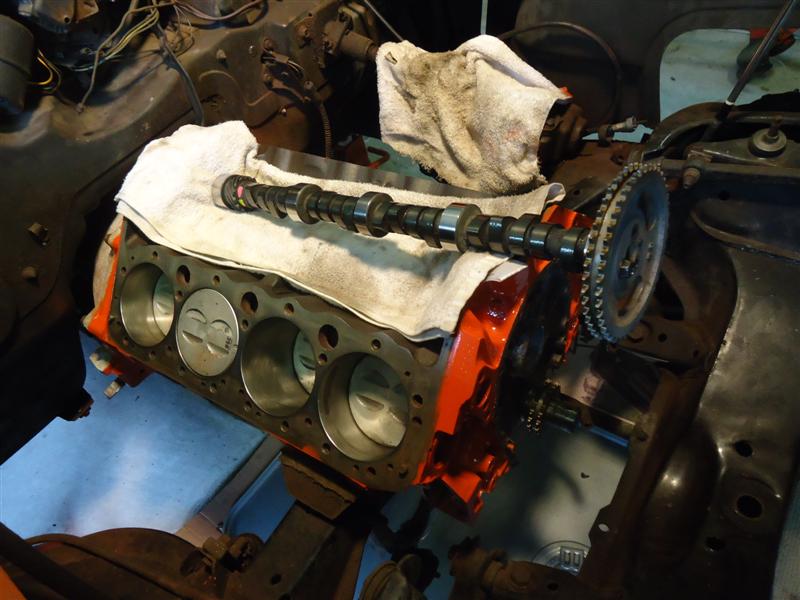
The best camshaft for your application will allow all engine components to work well together (carb, manifold, exhaust, etc).
Lift
To a point, the further the valve rises from its seat the more airflow can be released. At very high RPM, valve bounce may result. This happens when valve spring tension is insufficient to keep the valve following the cam at its apex. Too high a lift may also cause interference with the valve head and the top of the piston.
Duration
Duration is the number of crankshaft degrees of engine rotation during which the valve is off it's seat. As you increase the duration of the cam, you increase the peak horsepower, but at the expense of low end torque. Do not overdo the duration when selecting a camshaft. Over-camming is an all-too-common common mistake when building a street motor.
Because different measuring points are used for advertised duration, the industry established .050" of tappet lift as a common measuring point, allowing cams from different companies could be accurately compared.
If you can't decide between two cams, choose the milder one.
*************
Single Pattern vs Dual Pattern
Camshafts were originally designed with the same duration and lift on both the intake and exhaust lobes. These are referred to as single-pattern cams.
Through the years, cam manufacturers have found that many engines prefer more duration on the exhaust lobe than on the intake lobe. These are called dual-pattern cams.
*************
Edelbrock 2102 Camshaft Kit
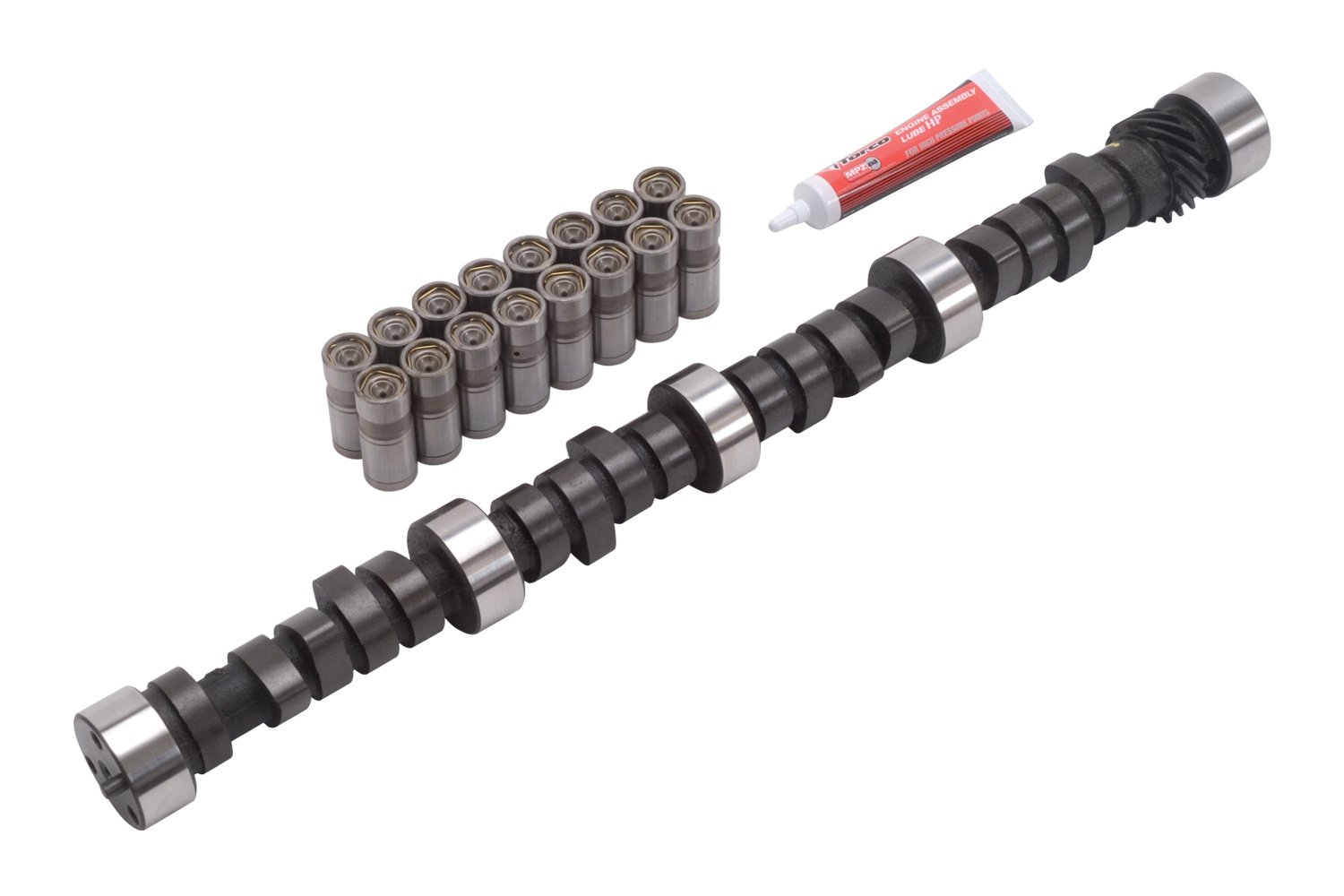
Here's one of Edelbrock's mid-performance cams for 1957-1986 Chevy small-blocks. The 2102 cam optimizes low to mid-range torque from off-idle to 5500 rpm. It features smooth idling for daily driven cars and light trucks.
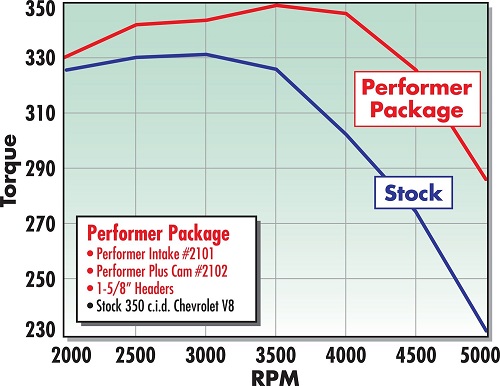
As you can see from the dyno chart results, there is an increase in throttle response and torque.
Edelbrock 2102 Cam Specs
- Advertised Intake Duration - 278 deg
- Advertised Exhaust Duration - 288 deg
- Intake duration: at .050 inch lift - 204 Degrees
- Exhaust Duration at .050 inch lift - 214 deg
- Intake Valve Lift - .420 in
- Exhaust Valve Lift - 0.442 in
- Lobe Separation - 112 deg
The 2102 cam kit includes camshaft, hydraulic lifters, assembly lube and instructions. It is to be used with stock ratio rocker arms only. Fits 1957-1986 small-block Chevy 283-400 V-8's and is 50-state legal.
Shop: Edelbrock 2102 Camshaft Kit
*************
Edelbrock 7102 Camshaft Kit
From Edelbrock's "Performer Plus" series, the 7102 cam features a more aggressive profile than the 2102 cam. It is designed to increase horsepower and torque from idle to 6,500 rpm.
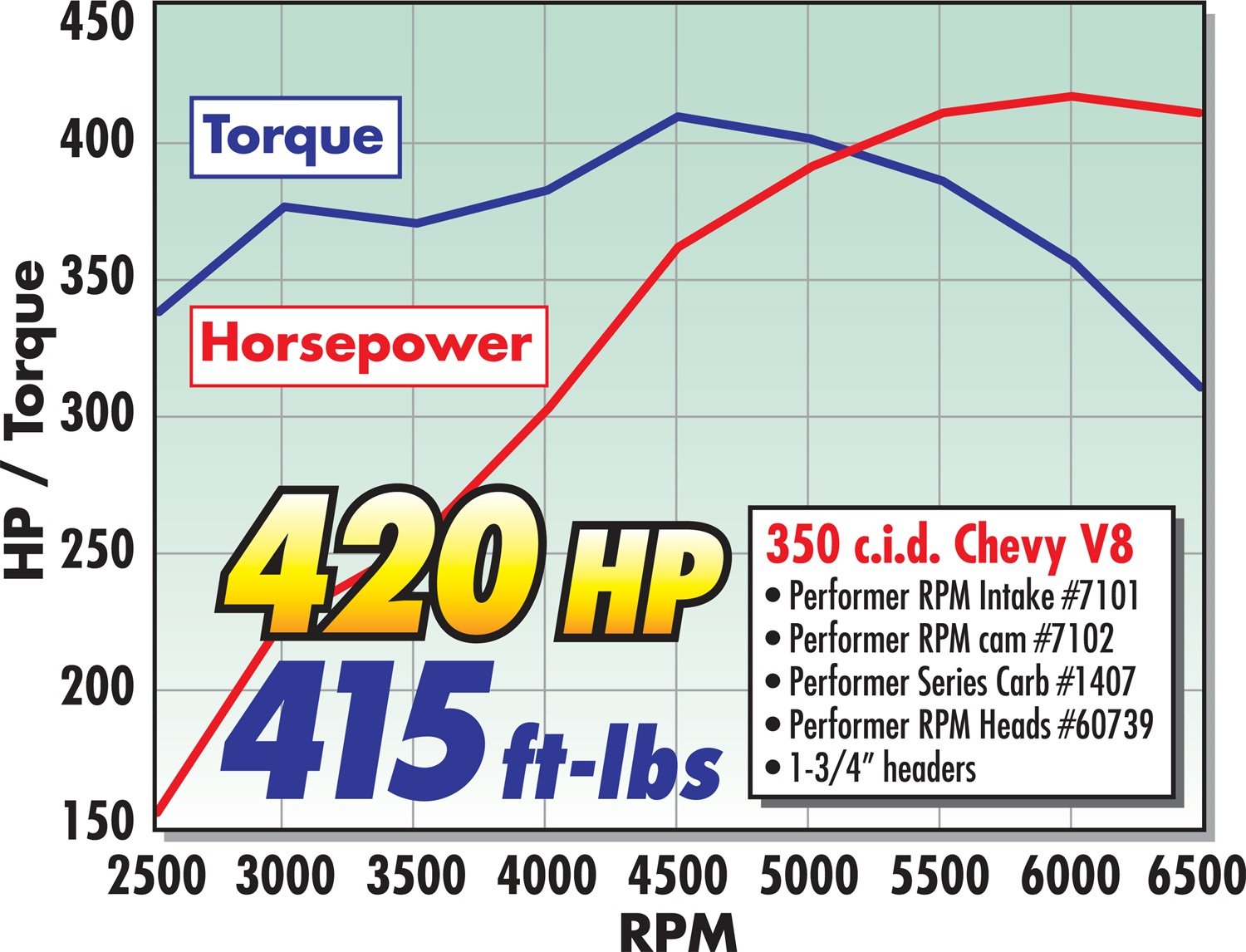
This is a good cam for high performance street use. It's also dyno-matched to Edelbrock's Performer line of intake manifolds.
Edelbrock 7102 Cam Specs
- Advertised Intake Duration - 308 deg
- Advertised Exhaust Duration - 318 deg
- Intake Duration .050 Inch lift - 234 deg
- Exhaust Duration at .050 inch lift - 244 deg
- Intake Valve Lift - 0.488 in
- Exhaust Valve Lift - 0.510 in
- Lobe Separation - 112 deg
Shop: Edelbrock 7102 Camshaft Kit
**************
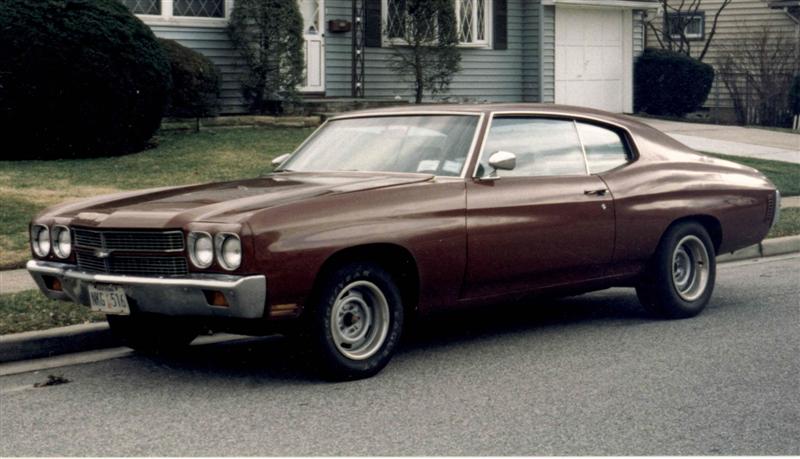
1970 Chevelle SBC Camshaft Selection
When I bought my old 1970 Chevelle, the engine had been modified with a slew of aftermarket pieces installed by the former owner. It made great power after 3,000 rpm, but was sluggish at lower RPMs.
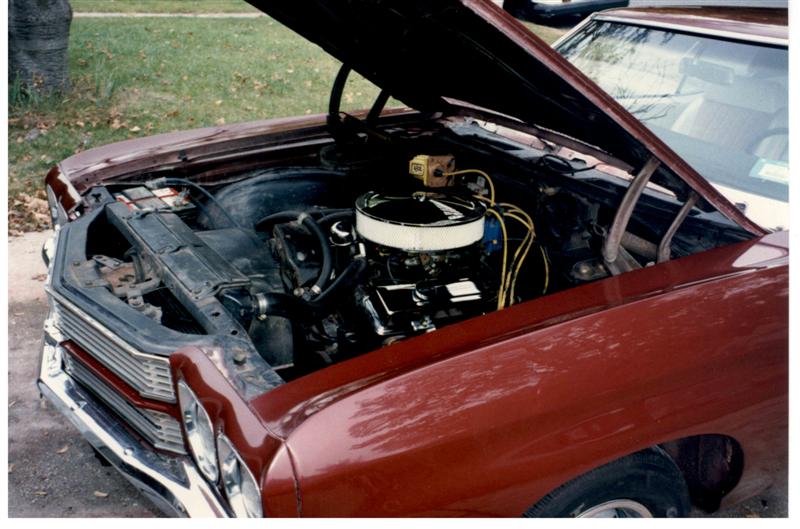
Since the car was to used as a daily driver, I needed to bring performance back to a streetable level. I took out a 350 horsepower cam and installed a 300 horsepower cam, along with new timing chain and gears.
Also removed was a single-plane intake manifold and double-pumper carburetor, replaced with a dual-plane manifold and Holley 1850 carburetor.
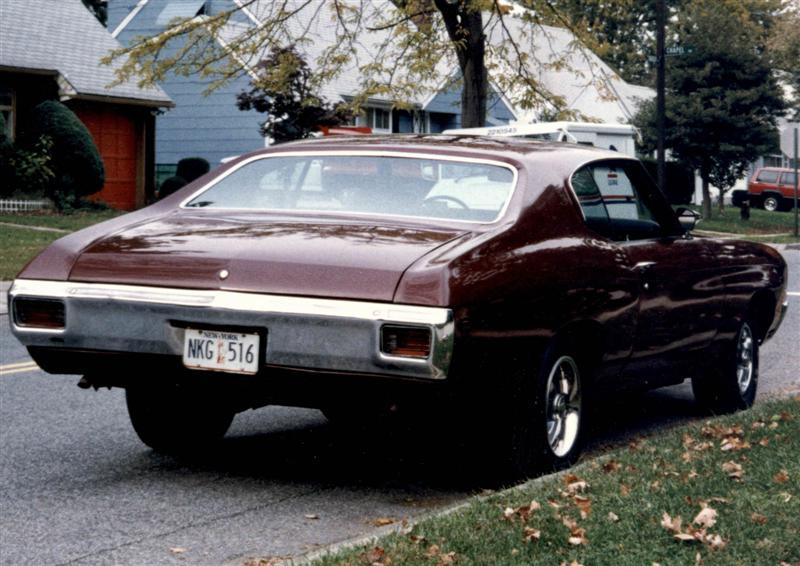
These changes made the Chevelle a good daily driver, and still made enough power for occasional bursts of "spirited" driving.
**************
Related Articles:
Best Heads For Gen-1 SBC
1970 Chevelle Restoration
1966 Corvette Project
327 Chevy Camshaft Installation
Gen 1 Cylinder Head Assembly and Installation
Install and Adjust Push Rods and Rocker Arms
SBC Timing Chain, Gears, and Cover
Best Oil for Classic Cars
Best Engine Assembly Lube
***************
NHRA Stock Eliminator Winner
Back around 2010, Wade Owens of Cape Girardeau, Missouri, ran a 283ci motor in a 1966 Chevelle, and successfully competed in NHRA's Stock Eliminator class. Duration on his cam was about 258/260 degrees at 0.050 inch, and lift for this engine combination was rules-limited to 0.399 inch, measured at the retainer.
With this relatively mild camshaft, Wade's Chevelle consistently ran in the mid-11s, which was at or under the national Stock Eliminator class record.
Read More about Wade here: Drag Central "Horsepower Happy"
***************