Stovebolt 6 History and Specs
Article by Mark Trotta
Durable, affordable, and powerful for their day, early Chevy 'straight-six' engines are often referred to as the 'Stovebolt' or 'Stovebolt-Six' because of the 1/4x20 slotted-head bolts holding down the valve cover, lifter cover and timing cover.
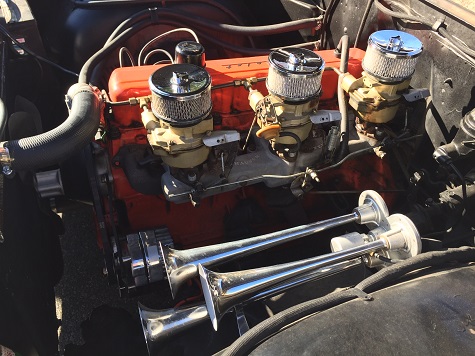
Pictured: Aftermarket 3x2 manifold and carbs on Chevy Stovebolt Six
Although only engines from 1929 through 1962 actually had the slotted-head bolts, the nickname stuck and eventually included all inline six-cylinder Chevrolet cars and trucks.
************
Chevy Stovebolt History
Introduced to the market in 1929, Chevrolet's new inline-six engine featured a bore and stroke of 3.3125" by 3.75", displacing 194 cubic-inches. Compared to the more common flathead engines of the day, it was an overhead-valve design and more complex.
194ci Engine (1929-1936)
Early Stovebolt engines featured forged-steel crankshaft and connecting rods, with three main bearings and cast-iron pistons. These engines were not named Stovebolt by Chevrolet, they gained that nickname later on.
216ci Engine (1937-1952)
With improvements in both durability and performance, an updated 216ci engine was introduced in 1937. This 'second-generation' inline-6 had a 46-pound crankshaft that was statically and dynamically balanced.
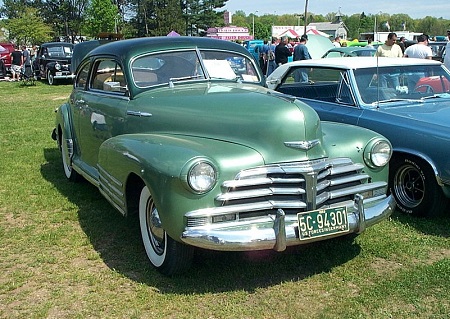
One drawback to the 216 version was, it did not have pressurized rod journal oiling, and their Babbitt bearings were not noted for longevity.
235ci Engine
In 1953, Chevrolet discontinued the 216 Stovebolt in favor of the 235ci engine, taken from Chevy's "Load-Master" truck series. Improvements included stronger crankshaft and connecting rods, aluminum pistons, and full-pressure lubrication. All pre-1953 engines were splash-oiled Babbitt bearing engines.
With 7.5:1 compression ratio, horsepower rating for the 235ci engine was 112 at 3,700 rpm. Torque was 200 pound-feet at 2,000 rpm.
Mechanical vs Hydraulic Lifters
In 1950, a 235ci Stovebolt with hydraulic lifters was offered with Chevy's new Powerglide automatic transmission, which were quieter and did not need periodic adjustment like mechanical lifters. Engines mated to manual transmissions continued use of mechanical lifters.
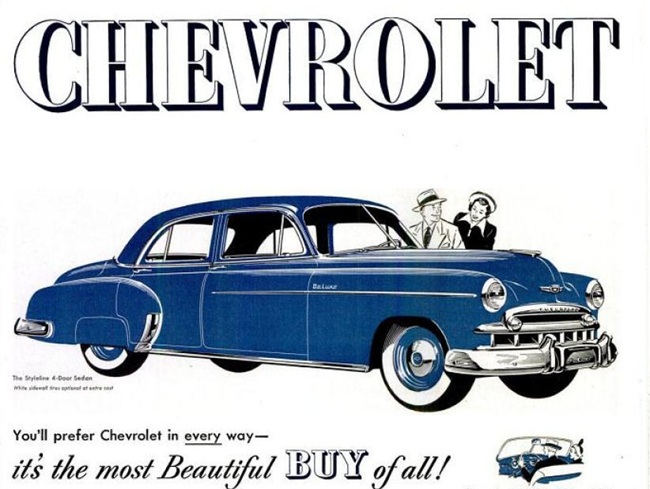
1953 Chevrolet
All 1953 Chevy's (except a few fleet vehicles) came standard with the 235 cubic-inch six, rated at 108-horsepower with standard transmission. When backed with a Powerglide automatic, power output was 115-horsepower. Engines with Powerglide-equipped models had a full-pressure oiling system.
************
Stovebolt-Six In Competition
At the 1953 Carrera Panamericana road race held in Mexico, driver C.D. Evans drove a Stovebolt-powered Chevy 210 to victory in the Light Stock Car class.
1953/1954 Corvette
As the 235ci Stovebolt was Chevy's only engine at the time, it powered all Corvettes in 1953 and 1954.
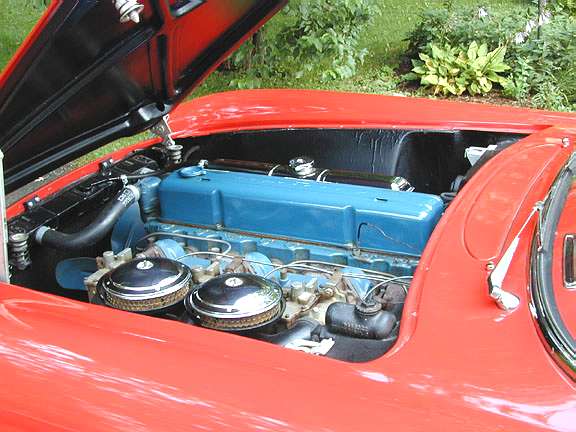
Blue Flame Six
Called the "Blue Flame Six", it was painted blue and mated to the Powerglide automatic transmission. The Corvette version had a higher 8.0:1 compression and featured a high-lift, long-duration camshaft with solid lifters. Power output was 150 horsepower at 4,200 rpm.
For the 1953-1954 Corvette, the Blue Flame Six featured three side-draft, single-barrel Carter Model YH carburetors, each carb feeding two cylinders. Dual valve springs were added to help achieve higher RPMs, and split exhaust manifolds rounded out the package. The Blue Flame Six was the only engine available in 1953 and 1954 Corvettes.
The 'Blue Flame' moniker had been used in Chevrolet advertising since 1934.
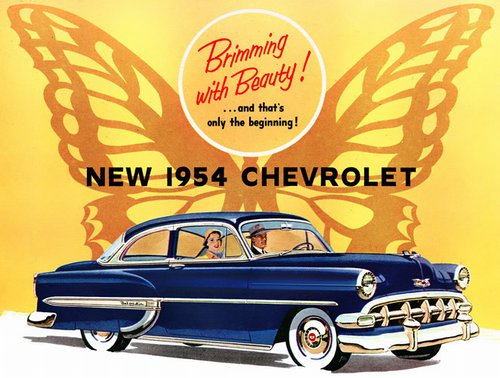
The Stovebolt-6 was Chevrolet's only regular production engine from 1929 through 1954. When the optional small block V8 debuted in 1955, it was relegated to base engine in passenger cars and light trucks.
Starting in 1956, all 235ci engines in passenger cars had hydraulic lifters.
The 235 was produced until 1962, and today is considered one of Chevrolet's best of all time engines.
Transmission Swaps
Starting in the mid-fifties, Chevy six-cylinder engines had revised bell-housings, making transmissions and starter motors interchangeable between the I-6 and V8 engines.
************
Chevy 230ci Engine
By the mid-sixties, not many car buyers were concerned about the economy of a six-cylinder engine, although Chevrolet continued to sell variants of the Stovebolt-Six.
In 1962, the 235ci engine was replaced by a third-generation 230ci straight-six. Part of the re-design was to share parts with the Chevy small-block V8.
The 230ci six was the base engine for 1967 through 1969 Camaros. It was also found in Chevelles and El Caminos, as well as several Oldsmobile and Pontiac models.
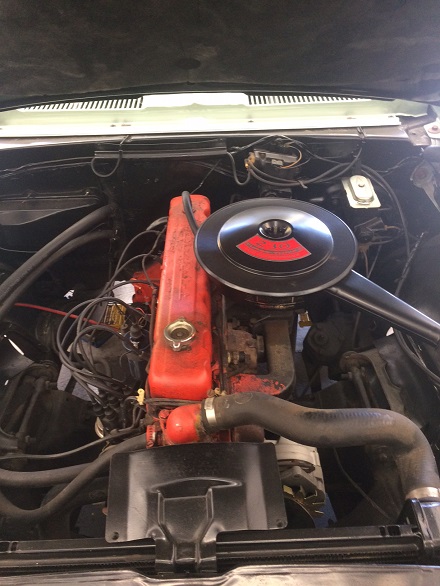
Improvements over the old engine included a seven main-bearing block, up from four in the previous version. Displacement later increased to 250ci, with production continuing until 1988.
Read: Spray Paint Engine
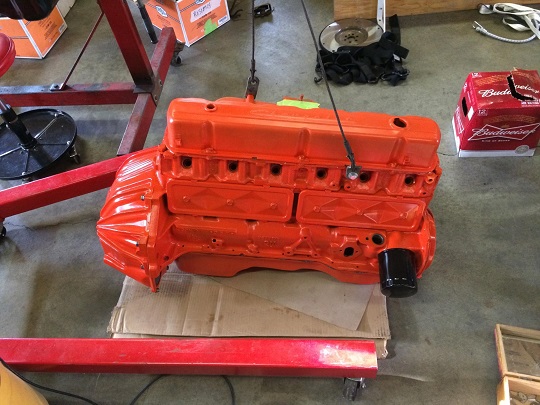
picture courtesy of Thomas Griffin
194ci Engine (Third-Generation)
The 194ci six was available in early Chevelles and Novas, and also some Chevrolet and GMC trucks. It was not offered in the 1/2-ton C/K series trucks. Bore and stroke was 3.56" in and 3.25".
One-Piece Cylinder Head
Between 1975 and 1984, an integrated cylinder head was produced for the Chevy straight six. This was an intake manifold and cylinder head cast as a single piece, presumably for cost savings. The extra weight sometimes resulted in warpage, and it was common practice to swap an earlier, non-integrated head in place of the integrated head.
Engine Identification
Finding and checking the casting numbers on the head and block is the easiest way to identify an old Chevy engine. You'll find the numbers on the passenger side of the block behind the distributor.
The letter/number combo will include the engine ID code, assembly plant code, production date and suffix code.
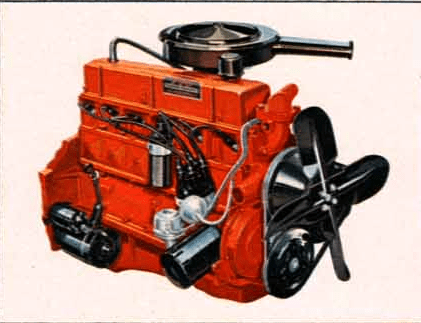
More info can be found at Chevy Stovebolt Website
************
Stovebolt Six Performance
Aftermarket performance goodies for Stovebolt Six engines include multi-carb intake manifolds and exhaust headers, to name a few. Other upgrades include generator to alternator swap and 6 volt to 12 volt conversions.
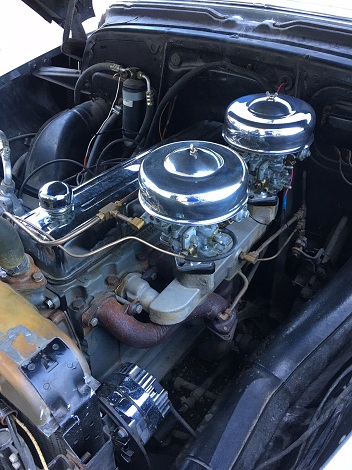
Pictured: Aftermarket dual carb manifold on Chevy Stovebolt Six
************
Notes and Misc
Firing order for 216, 235, and 261 Chevy engine's is 1-5-3-6-2-4. The cylinders are numbered 1-2-3-4-5-6 from the front of engine to rear.
************
Related Articles: