American Muscle Car History 1964-1969
Article by Mark Trotta
Although sixties muscle car sales were relatively low by Detroit production standards, they occupy a huge place in classic car history.
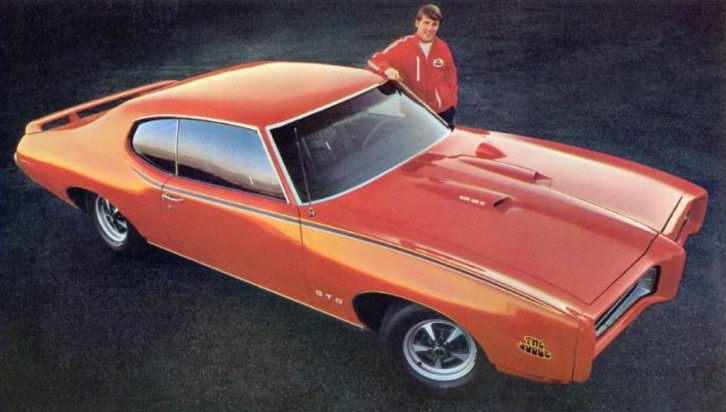
What Is A Muscle Car?
The most agreed upon definition, is that classic muscle cars were based on full-frame, intermediate-sized cars, and powered by a V8 engine displacing 300 cubic-inches or more.
Primarily designed for straight-line speed, they lacked sophisticated chassis, brakes, and suspension. But they were simple, durable, and fast, and unlike today's models, were actually affordable to young buyers!
American Youth Market
Muscle car history starts with Baby Boomers coming of (drivers) age and America's love for speed and competition. In the early sixties, on any given weekend, Dodge, Plymouth, GM, and Ford were battling each other for supremacy on drag strips across the U.S.
By 1964, Oldsmobile, Chevrolet, and Pontiac offered regular production muscle cars, with Buick joining in a year later. Ford offered the Fairlane 500 and later the 428 CobraJet.
Chrysler unveiled the 426 street Hemi engine in 1966, seen in the Dodge Charger, then later in the Plymouth GTX and Road Runner.
Pontiac GTO
In the early sixties, General Motors had a corporate policy which stated that intermediate-cars could not have engines larger than 330 cubic inches, but this policy did not seem to apply on options. Pontiac got around the rules by advertising a 389ci-equipped Tempest as a special-option model.
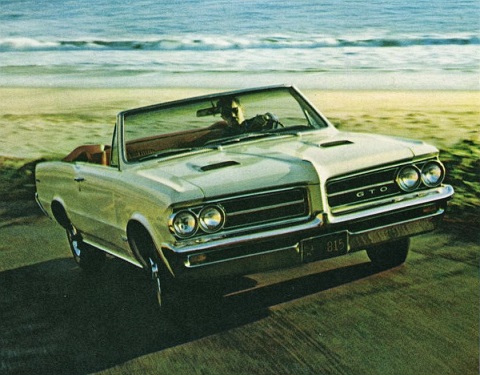
The GTO project, (spearheaded by Pontiac division president John DeLorean) technically violated GM's policy, and proved to be far more popular than expected. The sales success of the 389ci Tempest GTO prompted other car companies to use the same formula, and soon there were numerous imitators.
First Muscle Car ?
History clearly shows that Pontiac wasn't the first car company to drop a big motor in a mid-sized car, but they were the first to market a mid-sized car with a big motor.
Rivaling anything on the road in straight-line acceleration, the Tempest-based GTO was highly successful. By 1967, the GTO became it's own separate model in Pontiac's lineup.
********
In the 1960's, American cars with large V8's were averaging around 8 to 12 miles per gallon, but with premium gas prices at 35 cents-a-gallon, few people cared. Cheap gas and cheap horsepower was the order of the day.
********
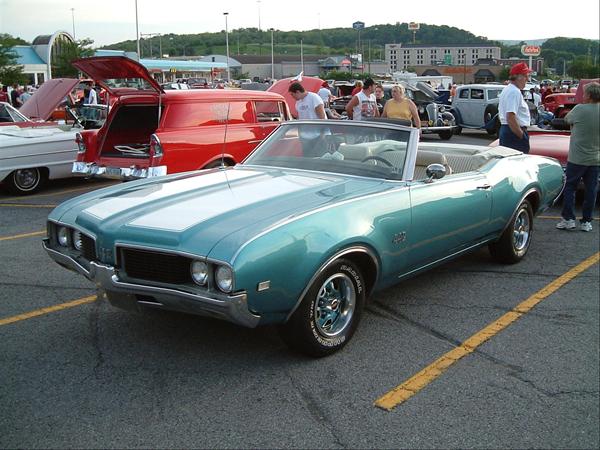
Olds 442
The name "4-4-2" (pronounced "four-four-two") stands for four-barrel carburetor, four-speed manual transmission, and dual exhausts. Like the Chevelle and GTO, the 442 was an optional trim level package on lower models (Olds Cutlass and F-85) for the 1964 model year. In 1965, engine size grew from 330ci to 400ci. The 442 became a model in it's own right in 1968.
Chevy Chevelle
Offered by Chevrolet for the model years 1964 through 1977, the Chevelle was offered in many body styles, including two-door coupe, four-door sedan, two-door station wagon, four-door station wagon, and convertible. The most sought-after of these are the two-door V8 coupes, which include the Malibu and SS models.
Chevelle SS396
After Chevrolet introduced their small-block V8 in 1955, they were virtually unchallenged on the street. That was until 1964, when the 389ci GTO appeared. The 1964 Chevelle was offered with either a 283ci or 327ci small-block engine. After Oldsmobile offered a 400-cid 442 and Buick a 401ci Gran Sport in early 1965, that was all it took for Chevy to break GM's policy for A-body series engines.
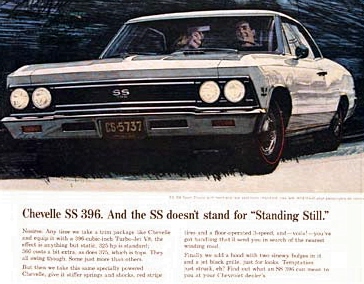
In 1965, a new big-block V8 displacing 396 cubic-inches was offered in full-size Chevys and Corvettes. It would also be available in the Chevelle Super Sport package.
Buick Gran Sport
Also based off the GM A-body platform was the Buick Gran Sport. Although a 300ci V8 was already offered in the Skylark, the Gran Sport came with the largest engine permitted by GM at the time, a 400ci V8. The engine was actually 401ci, but called a 400 because that was the maximum engine size allowed. The engine produced 325 horsepower and 445 lb/ft of torque.
In 1967, a 340ci version was added, sold as the GS 340 and the GS California sub-model. The following year, it was replaced with the GS 350. For 1968 and 1969, Buick offered a GS 400 in both convertible and hardtop model.
Dodge Charger
Sharing Mopar's B-body platform with the Coronet, the 1966 Charger came standard with a two-barrel 318ci engine producing 230 horsepower.
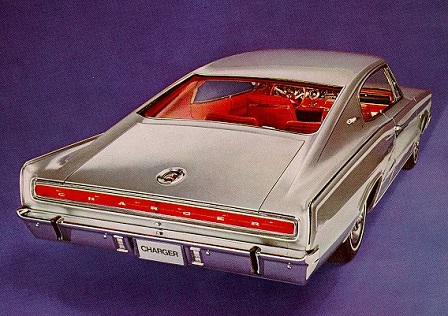
Optional was either a 265-horsepower 361 motor, a 325-horsepower 383, or a street version of Chrysler's 426 Hemi race engine.
First Street Hemi
When the 426 cubic-inch Hemi first appeared in 1964, it was strictly a racing engine. After Hemi-powered Mopars dominated the that year's Daytona 500 (finishing 1-2-3-4) they were quickly banned unless the motors were offered to the general public. This meant installing them in regular production vehicles.
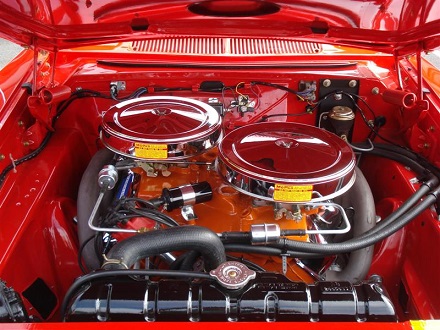
Huge by any standards, the 426 Street Hemi was nicknamed "Elephant Engine" not only for its cubic capacity and power, but for its 800-plus pound weight. The first street Hemi appeared in 1966 B-body Dodges and Plymouths, including the first-year Dodge Charger.
Plymouth GTX
Introduced as the Belvedere GTX in 1967, the Plymouth GTX was available in both hardtop and convertible body styles, with 1969 being the last year for the convertible.
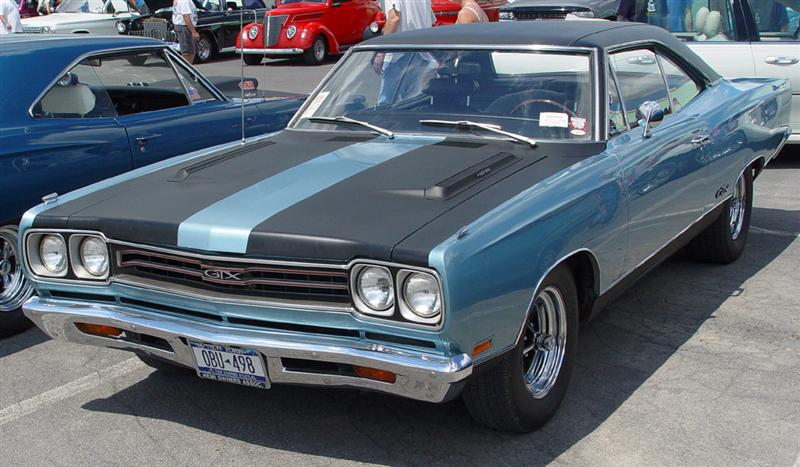
For 1969, the GTX received minor cosmetic changes, along with an optional Air Grabber hood (standard with Hemi-powered models). The standard "Super Commando" 440 V8 was rated at 375 horsepower, and the optional 426 engine produced over 425 horsepower.
In stock trim, a GTX 440 with automatic transmission and 3.23 rear gears ran the quarter-mile in 14.4 seconds at 98 mph.
Due to increases in optional equipment and luxury appointments, muscle cars gradually became more expensive to purchase. In response to rising cost and weight, a secondary trend towards more basic "budget" muscle cars emerged in 1967 and 1968.
Plymouth Road Runner
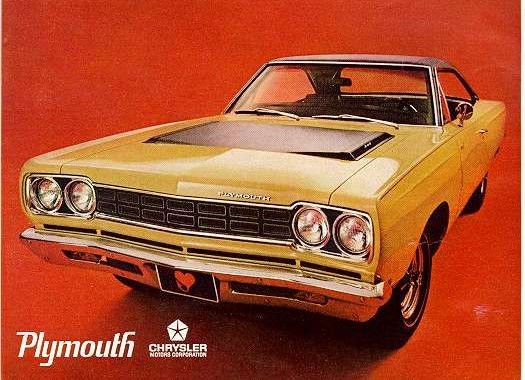
Although Plymouth's bare-bones muscle car had a plain vinyl bench seat and few options available, everything essential to performance was there, including the standard "Road Runner 383" V8 rated at 335 horsepower and 425 lb/ft of torque. Optional was the 426ci Hemi, rated at 425 horsepower and 490 lb/ft of torque. The standard transmission was a 4-speed manual with floor shifter. Chrysler's three-speed TorqueFlite automatic was optional.
Road Runner Sales
Plymouth expected to sell about 20,000 Road Runners in 1968. Actual sales numbered around 45,000. This placed the Road Runner third in sales behind the Pontiac GTO and the Chevelle SS396.
Equipped with an aftermarket carburetor and slick tires, a 383ci Road Runner could run a 14.7 quarter-mile at 100.6 mph.
Ford Torino GT
After the successful 390ci Fairlane GT and GTA (and Comet Cyclone), Ford followed up with the introduction of the Torino in 1968. The Torino was initially an upscale version of the Fairlane, with the most popular-selling models being the 4-door sedans and 2-door hardtops.
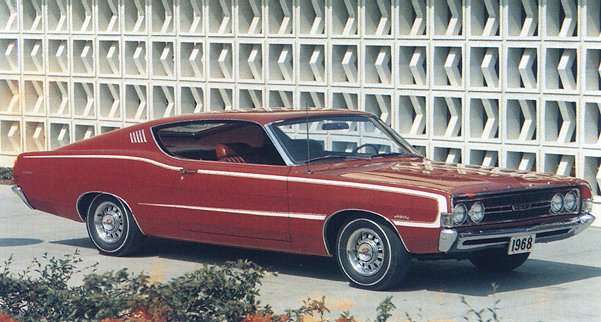
The GT model came standard with a 302ci V-8 engine, bucket seats, console, tachometer, and power front-disc brakes. An available 335-horsepower 428ci CobraJet V-8 propelled the Torino into muscle car stardom.
428 CobraJet
Based on the Torino GT, the CobraJet Torino came standard with the 428 CobraJet motor, 4-speed manual transmission, heavy-duty suspension, and F-70x14 tires mounted on six-inch wheels. Options included a functional Ram-Air hood scoop, and a "Traction-Lok" limited-slip differential with choices of gearing.
Exterior features included a blacked-out grille, hood lock pins, and Cobra emblems. Special red and chrome 428 badging to set them apart from the standard GT model.
Torino transmission choices were three- or four-speed manual, or three-speed automatic. Also available was a suspension package with heavy-duty shocks and a front stabilizer bar.
A 1969 Fairlane Cobra 428 with an automatic would run 13.50- 14.0 ETs at 100+ mph.
American Motors Corporation
AMC began gaining credibility with muscle car fans in 1967, when it offered the Rebel and the fastback Marlin, both available with a 280 horsepower 340ci V8. A year later, the Javelin pony car and two-seat AMX debuted, both offered with a potent 390ci V8.
SC/Rambler
Built in collaboration with Hurst Performance, the one year only 1969 SC/Rambler ("Scrambler") was built off the compact two-door American model, and could be ordered in solid blue or with bold exterior graphics and red, white, and blue paint scheme.

Under the hood was a 390ci V8, coupled to a 4-speed close-ratio manual gearbox with Hurst linkage, and heavy-duty 10.5" clutch. The "Twin Grip" rear axle featured 3:54 gears.
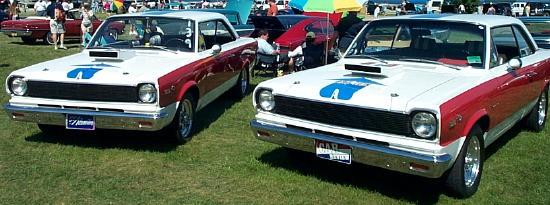
With 315 horsepower under the hood, the 3,000-pound car was one of the fastest American cars you could buy in 1969.
Dodge Charger Daytona
From it's wedge-shaped nose to the 23" tall rear wing, the 1969 Daytona Charger measured 18-feet long and was capable of speeds no other production car could match.

Standard equipment included heavy-duty suspension and brakes, and the Torqueflite three-speed automatic transmission. A four-speed manual was optional.
Base motor was the 440 cubic-inch 'Magnum' V8, producing 375-horsepower at 4,600 rpm, with 480 lb-ft of torque at 3200 rpm. An optional 426 Hemi motor was rated at 425-horsepower at 5,000 rpm and had 490 lb-ft of torque at 4000 rpm.
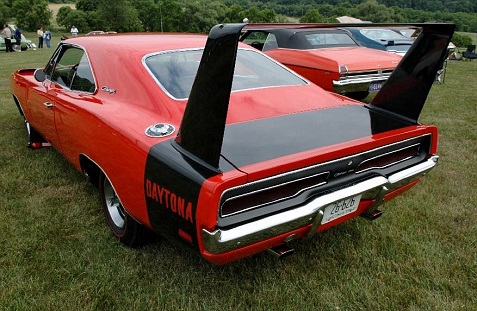
Offered as an option package, the Dodge Charger Daytona was produced for just two years (1969 and 1970).
NOTE: Sister-company Plymouth applied the Daytona formula to the Road Runner, creating the one-year 1970 Superbird.
********
Related Articles: