Troubleshooting Points Ignition on Old Cars and Trucks
Article by Mark Trotta
Old cars and trucks are simple, that's part of the reason why we like them. If your points ignition vehicle is not getting spark, here are step by step procedures on how to troubleshoot the problem.
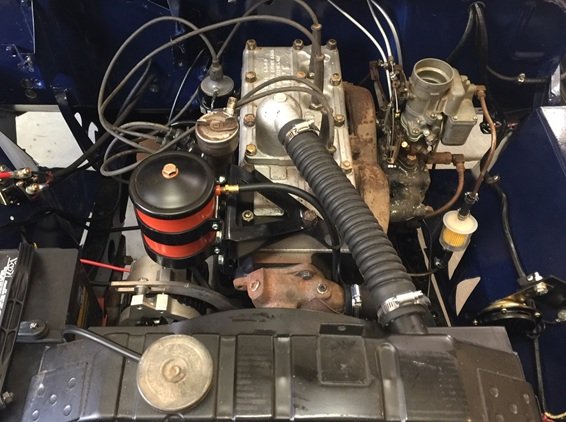
Tools Needed
You'll need a few basic tools that you may already have.
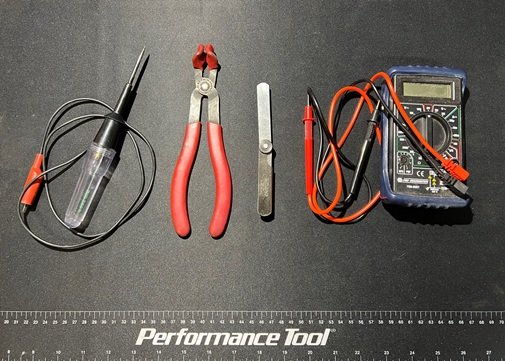
Pictured left to right: test light, insulated pliers, feeler gauge, digital multimeter.
*******
Where To Begin
Start by seeing if there's spark at the spark plugs. Take out one plug, re-attach the cable, and hold the tip to a ground (with insulated pliers!) while a helper cranks the engine.
*******
CAUTION: Never touch any part of the secondary ignition circuit when engine is cranking or running.
*******
If you're not getting spark at the plug, the next step is to check the ignition coil.
Check For Spark To The Coil
Automotive ignition coils have an entry and an exit. To check that electrical current is reaching the coil, first pull the main high-tension wire out of the distributor cap.
Next, turn the ignition switch on, but don't engage the starter.
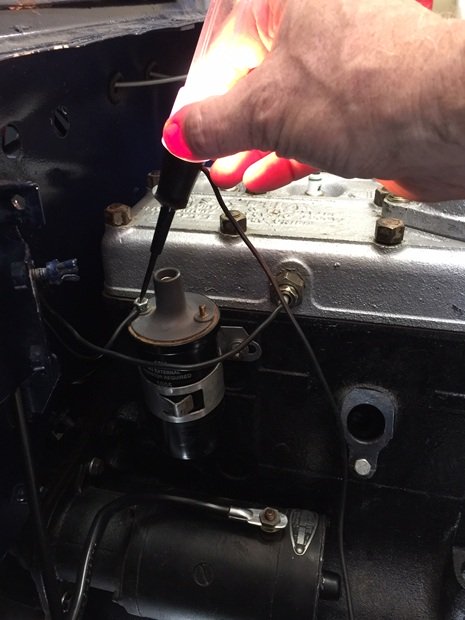
With an electrical test light, check for battery voltage at the positive (+) terminal of the ignition coil.
If there is no power, check that the ignition switch is getting power. Also check if there's a fuse or ballast resistor (more on ballast resistors below).
If it lights up, get a voltage reading with a multimeter.
*******
6-Volt Troubleshooting
When you buy an electrical test light, it will have a 12-volt bulb in it.
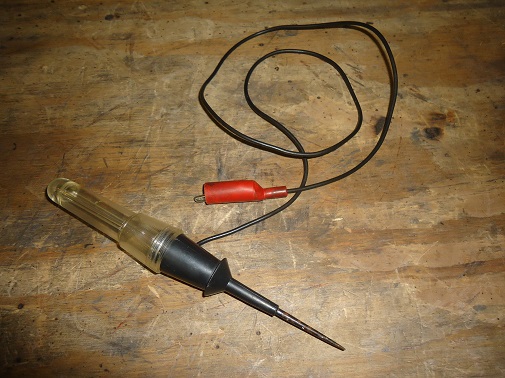
If used on 6-volt systems, the bulb will glow very dimly or not at all, which can lead to false readings. It's best to replace the bulb with a 6-volt.
*******
Check For Spark From The Coil
Pull the main high-tension wire out of the distributor cap. With insulated pliers, hold the metal terminal about 1/4" away from a clean engine ground.
Crank the engine and look for a strong, blue-white spark jumping to ground.
If you have a spark from the coil wire but not at the spark plugs, inspect the cap and rotor for cracks, carbon tracking, or corrosion.
*******
Voltmeter Test For Ignition Coil
On a 12-volt ignition, a voltmeter should give you a reading of about 12 volts at the coil. If the coil uses a ballast resistor, the reading will be about 7 volts.
If there is no voltage, there is a break in the circuit between the battery and the positive terminal. Possibly the ballast resistor is faulty.
NOTE: Sometimes when coils go bad, they are only bad when warm and will stop sending spark.
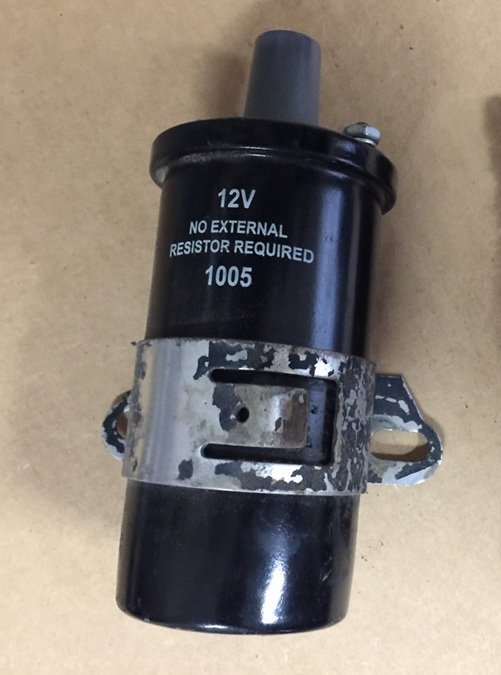
If in doubt, replace it. 12-volt coils for old cars and trucks are inexpensive.
*******
Check For Spark At The Points
Test 1) Take off the distributor cap, turn on the ignition (usually the first click over to the right), but don't start the engine. With your fingers, twist the points (by rocking the rotor).
Are they sparking as they're opening and closing?
Test 2) Remove the distributor cap and rotor, turn on the ignition (usually the first click over to the right), and have a helper crank the engine.
Are the points opening and closing and sparking as the engine is cranking?
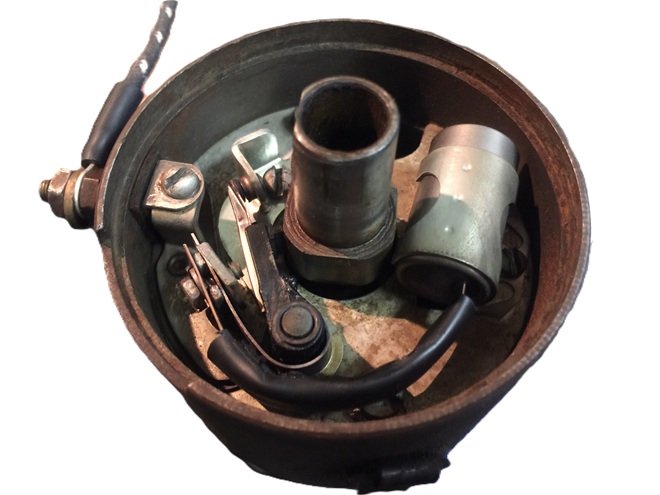
Visually Inspect Points
With the distributor cap and rotor removed, look at the contact surfaces of the points.
Pitted, burned, or misaligned points weaken the electrical current to the coil, causing a weak or missing spark. If they are burned or pitted, replace them. Good parts stores (the ones with old people behind the counter) still carry them. Or you can order them online.
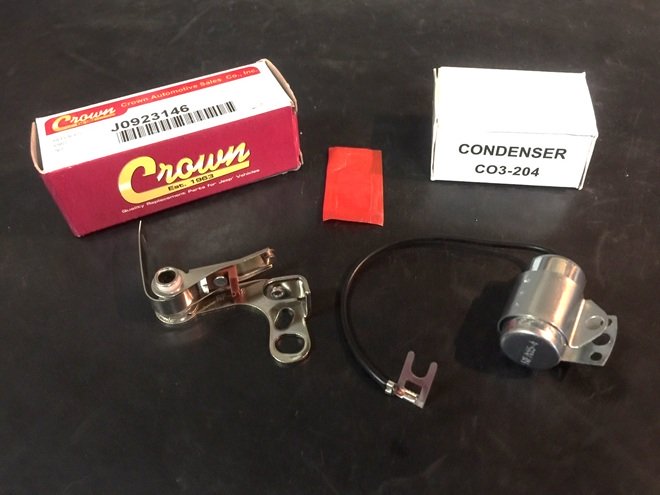
Are you bending over the fender while changing the points and condenser?
There's an easier way!
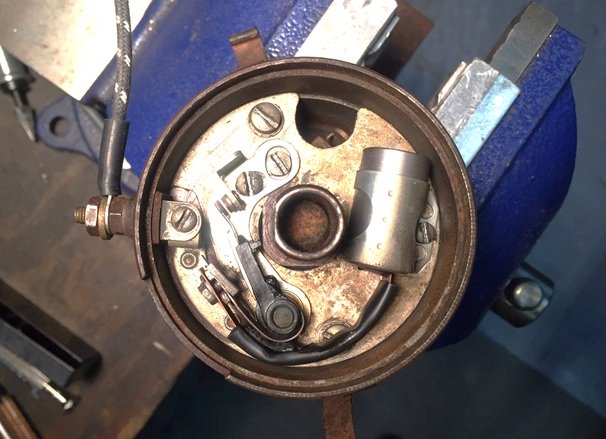
Many techs don't like the idea of removing the distributor and propping it in a workbench vice. It took me a few times before I was comfortable with it. But if you plan on doing this more than once, it'll save you quite a bit of time and effort.
*******
Cleaning and Renewing Points
If the points are not worn, just dirty or greasy, you can probably get away with cleaning and renewing them.
If they are not burnt or pitted, contact points can often be cleaned up with a points file.

These are speciality files which should not be used for other types of filing, so as not to clog it with small metal particles.
TIP: When done, run a 3x5 index card through the points once or twice. This helps remove any unwanted grease.
Avoid using sandpaper to file points, as it will leave tiny particles of grit.
Condenser
A bad condenser can cause weak spark or engine stalling when warm, but you cannot tell by looking at one if it is good or bad.
Replace it if there's any doubt as to it's age or condition.
*******
Ballast Resistor Function
Too high an amperage can damage the surface of ignition points and cause failure. A ceramic ballast resistor is designed to extend the life of both coil and points. You can also call it a current limiting resistor.
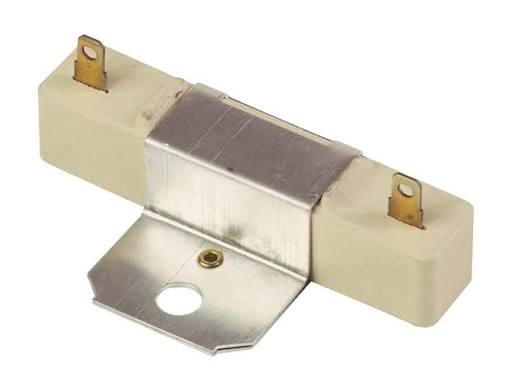
Pictured: MSD 8214 ballast resistor.
On one side, current runs through it normally; the other side is for starting, which bypasses the resistor to provide extra power.
When the ignition key is in the start position, full current is applied to the coil and increases voltage to the spark plugs. Once the engine has started, the coil is fed in the usual way from the ignition switch.
A ceramic resistor is often clamped to one of the coil mounting bolts.
Make sure it is not cracked, and that the connectors are tight.
Ballast Resistor Test
You can use an electrical multi-meter to test ballast resistor function. Set your multimeter to the Ohms (Ω) setting or low resistance scale. With the wires disconnected, check the resistance between the two terminals of the ballast resistor.
Touch the test probes to each terminal of the ballast resistor.
On a single ballast resistor (two prongs) readings around 1.2 to 1.8 ohms are typical (check your specific vehicle manual for exact factory specs).
On a dual ballast resistor (four prongs), one side should measure around 1.2 ohms and the other side around 5 ohms.
Any significant difference from the factory specs would indicate that the ballast resistor is defective.
*******
Resistor Wire Function
Some points ignition vehicles have a special high-resistive lead (usually rated around 1.2 to 1.8 ohms) from ignition switch to coil. You can use a ballast resistor in place of a resister wire, and vice versa, providing the total resistance matches what your ignition coil requires.
*******
Spark Plugs
Automotive spark plugs vary in type and in design. They should be clean and correctly gapped, and be the correct application for your engine.
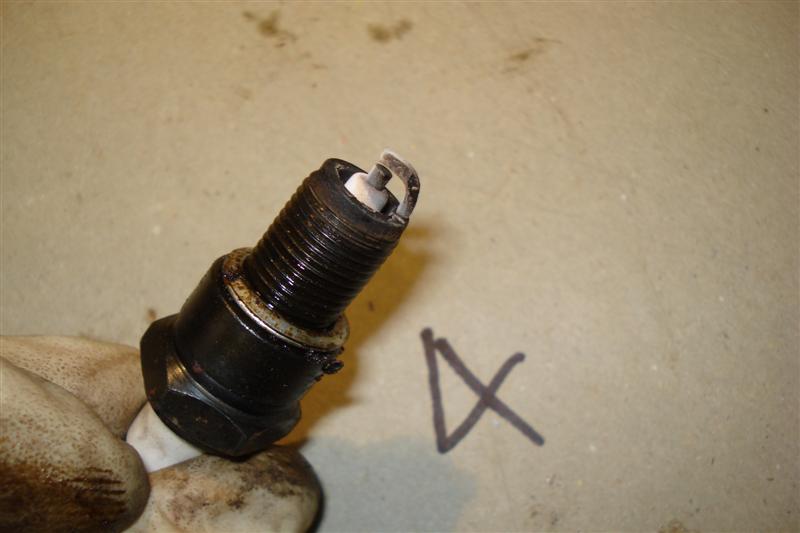
The spark plugs you take out of a 50 year-old vehicle have probably been replaced 10 or 15 times. Don't assume they are correct for that year, make, model, and engine. Look at the part number on the plug and check with a service manual.
If one has a cracked porcelain insulator, throw it away and get a new one.
*******
Spark Plug Cables
Most ignition wire cable is made with a carbon core in two resistances so that leads of different lengths will have equal resistance. Some have a copper core which have very low resistance.
Spark plug cables can be easily tested with a multimeter.
Detach each wire in turn. Take off the plug cap if it is removable. Select the resistance position, then touch a probe to each end of the wire and read the resistance on the scale.
If one reading is much different than the others, you've found your misfire. Probably best to replace the whole set.
Conclusion
Compared to today's modern vehicles, fixing a non-spark issue on an old car or truck is simple to diagnose. Once properly set, a points ignition will run fine for 5,000 miles or more, without any adjustment. For a classic or vintage vehicle that gets driven 1,000 miles a year or less, that's a pretty trouble-free system.

The vehicle in this article is a 1948 Willys CJ2A that was upgraded from 6 volts to 12 volts.
*******
Notes and Misc
If a points ignition vehicle is left in the run position without the engine running, and the points happen to be open, electrical arcs can cause raised spots on the points resulting in a change in dwell timing, or an engine that won't run at all.
*******
Related Articles: